Speckled Robin's Egg Macarons with Milk Chocolate Fudge
These Robin’s Egg Macarons bring you vanilla macaron shells with a rich milk chocolate fudge filling…
- Prep
- 25 mins
- Cook
- 14 mins
- Resting Time
- 40 mins
- Total
- 1 hr 19 mins
- Makes
- 22 servings
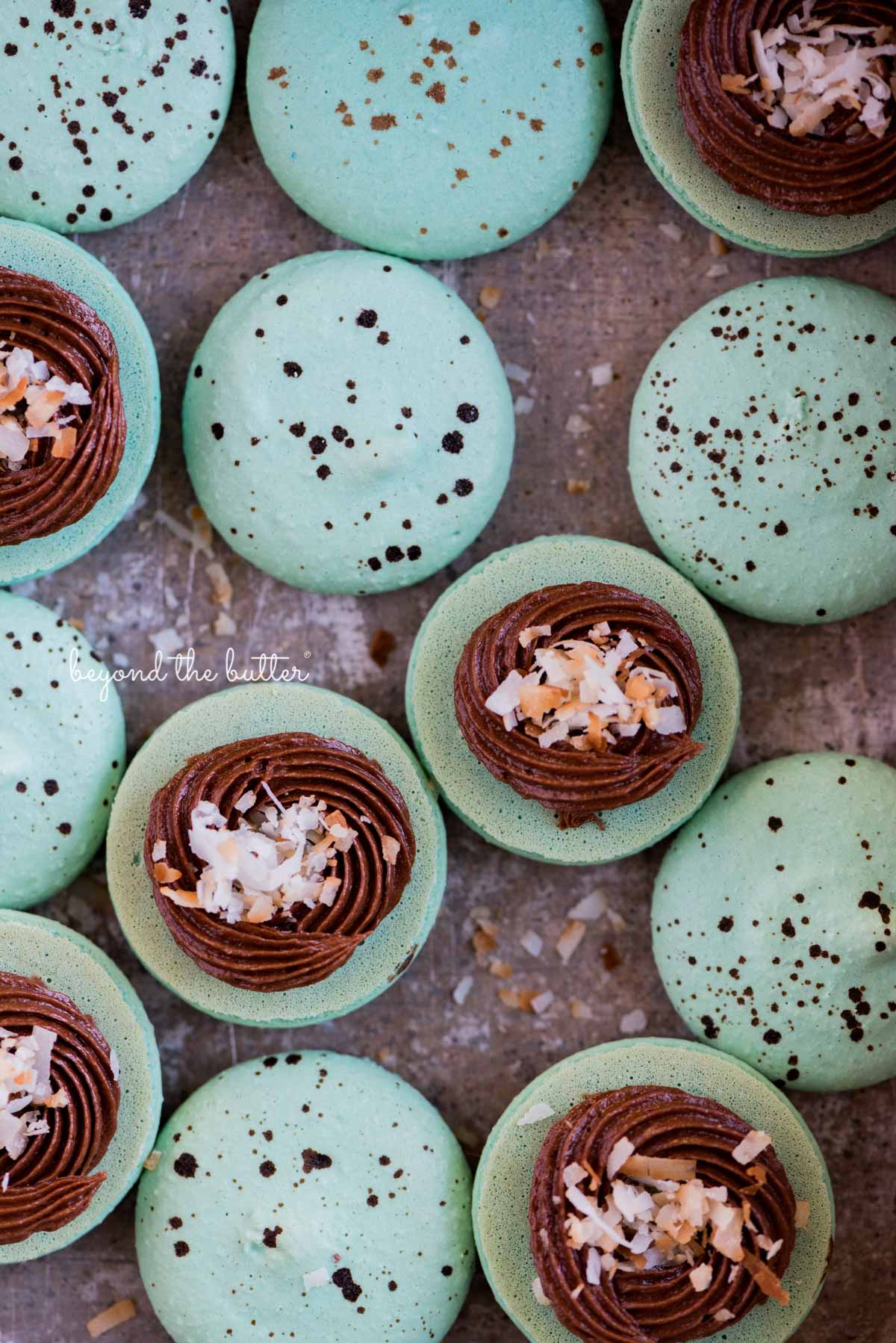
Here is a Robin’s Egg Macarons recipe that pairs vanilla macaron shells with a silky milk chocolate fudge frosting and toasted coconut flakes. It’s a charming, tasty treat for Easter and springtime!
Recipe Overview
This recipe uses the Swiss method, which (in my opinion) is a great place to start if you are new to making macarons.
I have tried all three techniques (Swiss, French, and Italian), and Swiss is my top pick. My dark chocolate macarons and lemon bar macarons are made this way too.
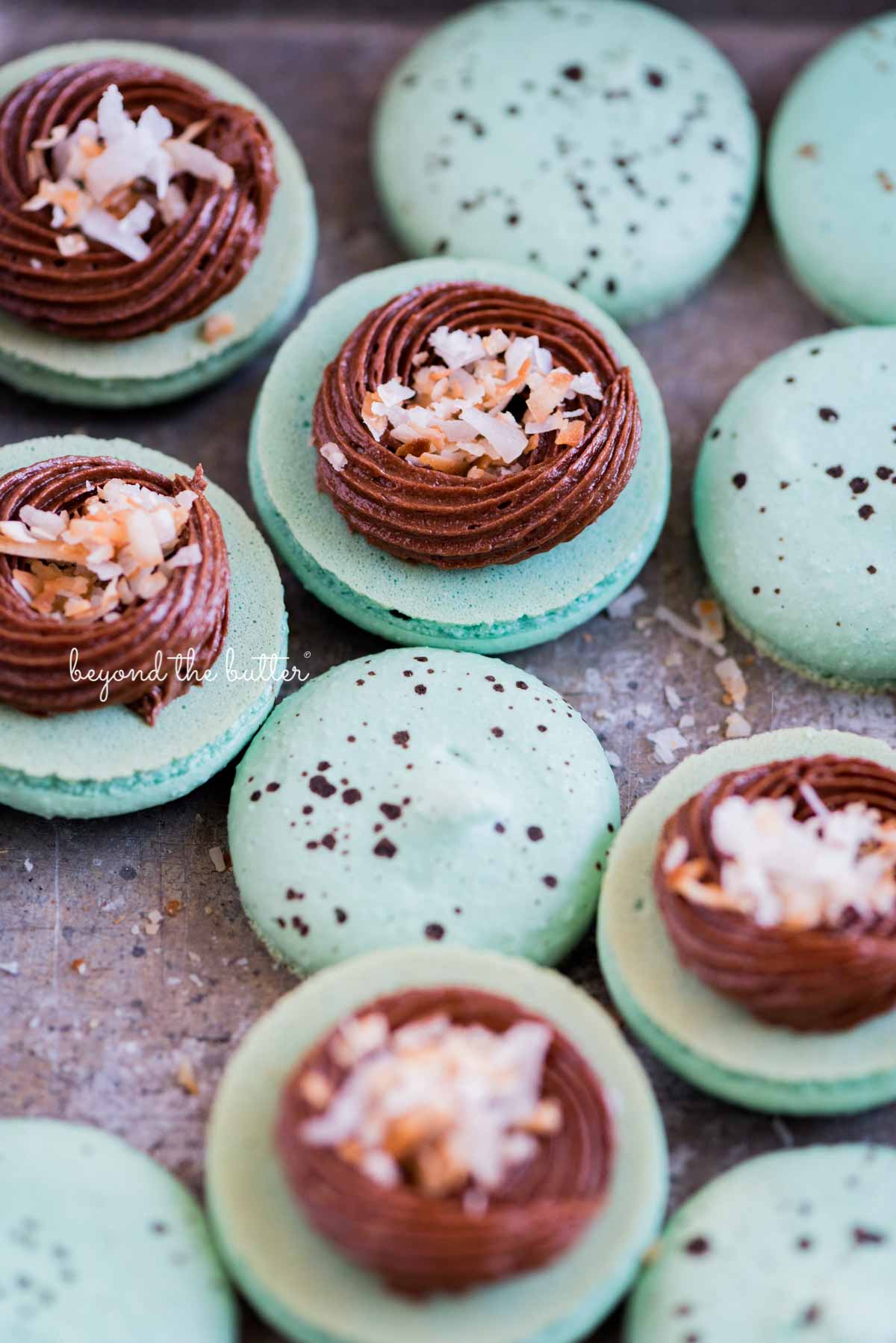
The vanilla flavor in these macaron shells is outstanding, and the list of ingredients is short. The crisp outsides and chewy middles are colored the classic robin’s egg blue and speckled with brown, so they taste great even by themselves!
But then you would miss out on the super creamy milk chocolate fudge frosting and the toasted coconut in the middle!
These robin’s egg macs are truly fantastic, absolutely perfect, and a sweet pick for spring Easter baskets!
What You’ll Need
Macarons have a reputation for being fussy, but they call for very few ingredients, which helps. Here is what to gather.
Macaron Shells
- Almond Flour. Also called almond meal. Sift it at least twice to get rid of any clumps.
- Domino® Powdered Sugar. Sift it at least twice, just like the almond flour. Then I like to sift the two together one more time.
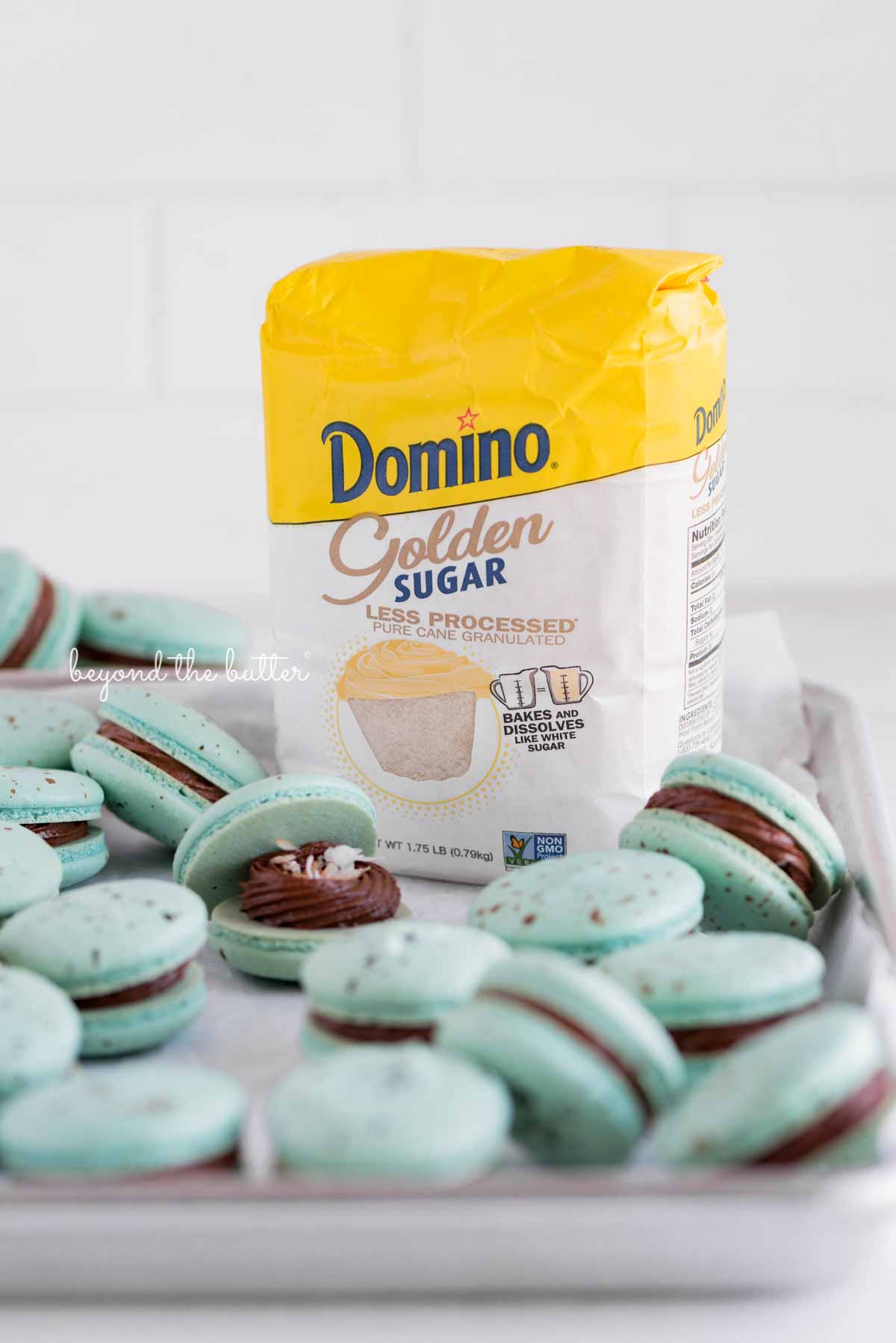
- Domino® Golden Sugar. This is my go-to sugar for macarons (and most other recipes too). It is less refined and has a light touch of molasses. You can swap it 1:1 for plain white granulated sugar.
- Egg Whites. Let your egg whites reach room temperature (or age them). I suggest setting them out at room temperature for at least 1 hour before you begin.
- Vanilla Extract. I really enjoy using vanilla extract in this recipe. Two teaspoons give these macarons a lovely flavor. Choose pure vanilla extract over clear or imitation. You will also need a little for the brown food coloring below.
- Blue Food Coloring. I suggest gel food coloring instead of liquid for this one. Gel is far more concentrated and vivid. I only used 2 drops of gel, since a little goes a long way!
- Brown Food Coloring. This creates the brown flecks you often see on robin’s eggs. You will only need 1-2 drops. As with the blue, I recommend gel. For a lighter fleck, mix in 1/4 teaspoon of vanilla extract to soften the color.
Frosting
- Unsalted Butter. It should be at room temperature.
- Domino® Powdered Sugar. For the frosting, sift this too.
- Unsweetened Cocoa Powder. Sift this as well. Your frosting will be much smoother that way.
- Salt. It rounds out the flavors.
- Light Corn Syrup. This is the ingredient that gives the frosting its smooth, creamy texture.
- Vanilla Extract. It ties all the flavors together. As above, use pure vanilla extract. Go for the good stuff!
- Milk Chocolate. You need only 2 ounces for the frosting. A good quality chocolate bar makes a real difference.
This robin’s egg macarons recipe also calls for coconut flakes. They are optional, so if you have a coconut skeptic in your household (like my husband), you can skip them!
Or you can halve the amount and use it on just a few of the macarons.
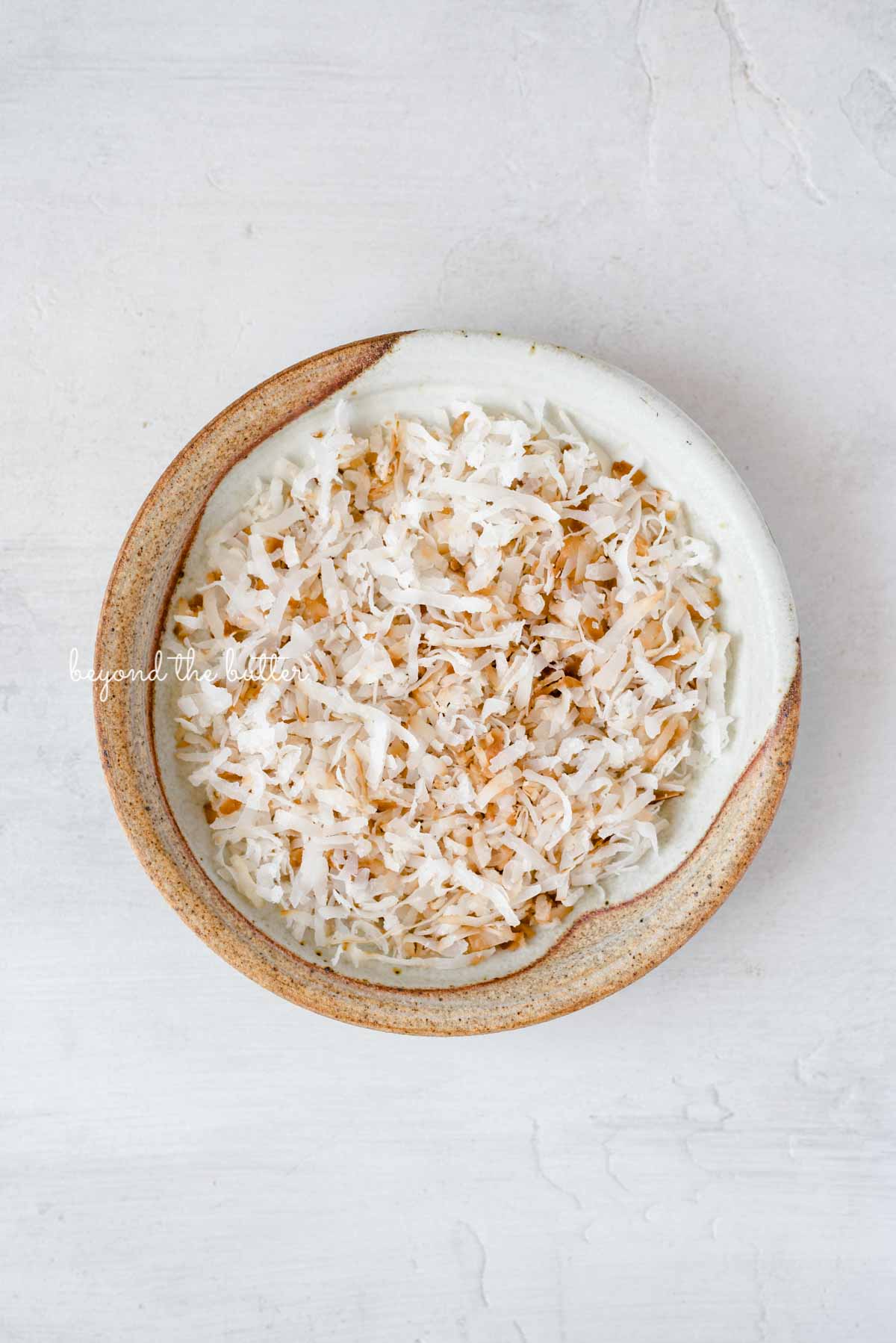
Toasting Coconut Flakes
There are two easy ways to toast coconut flakes:
Small Skillet. Put the coconut flakes in a small skillet over low-medium heat. Keep moving them around the pan while they heat.
After 2-3 minutes the flakes will smell toasted and turn golden brown. When they are toasted to your liking, take the pan off the heat right away and spread the flakes on a plate to cool.
Microwave. Spread the coconut flakes on a microwave-safe plate and heat them in 30-second bursts, stirring with a fork between each one. A little smoke may rise from the flakes. That is normal.
Never heat the coconut flakes for more than 30 seconds at a time. Once they are toasted to your liking, transfer them to a plate to cool.
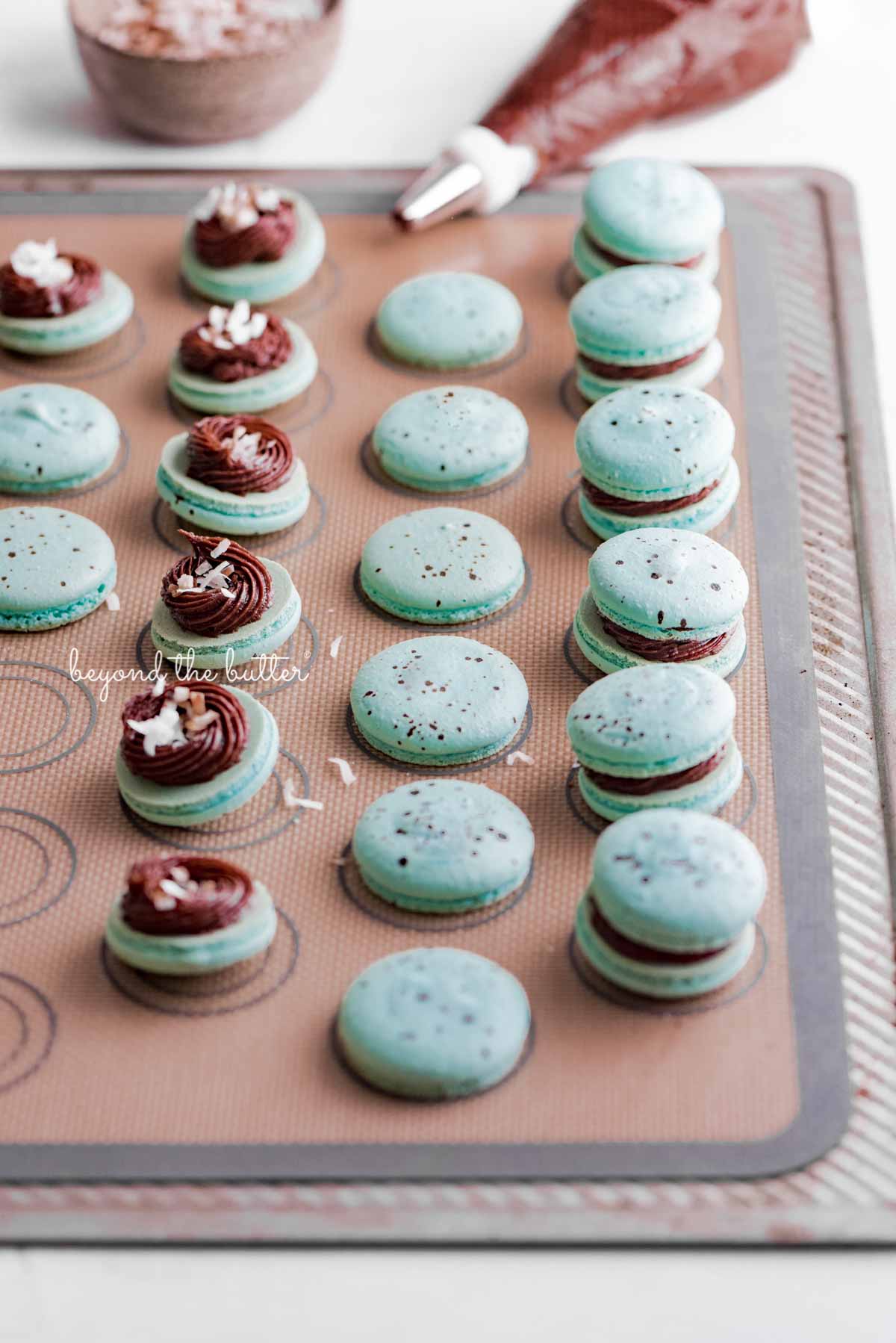
Essential Baking Tools
Here are a few tools I recommend for making these springtime robin’s egg macarons.
Food Scale. This is the most important tool on the list and it makes a huge difference! I strongly, STRONGLY suggest weighing ingredients instead of using measuring cups for this recipe.
Large, flat baking sheets. Flat sheets let air move around the macaron shells while they bake.
Double Boiler. You need this to dissolve the Domino® Golden Sugar into the room-temperature egg whites. Use a heatproof glass bowl set over a saucepan holding 1 – 1 1/2 inches of simmering water.
Silicone baking mats. Some bakers use parchment, but I prefer silicone. They have never caused me trouble when I peel the macarons off.
Hand Crank Sifter. The almond flour and Domino® powdered sugar need to go through a sifter several times to remove lumps.
Oven Thermometer. These are inexpensive and useful for any baking, especially if your oven temperature runs off.
Large Piping Bag and Decorating Tips. A medium to large piping bag works well for the amount of macaron batter. A small piping bag is fine for the milk chocolate fudge frosting.
For the tips, I used an open round tip for the macaron batter and a small decorative tip for the frosting.
Beyond the list above, these other baking tools are handy when making your robin’s egg macarons!
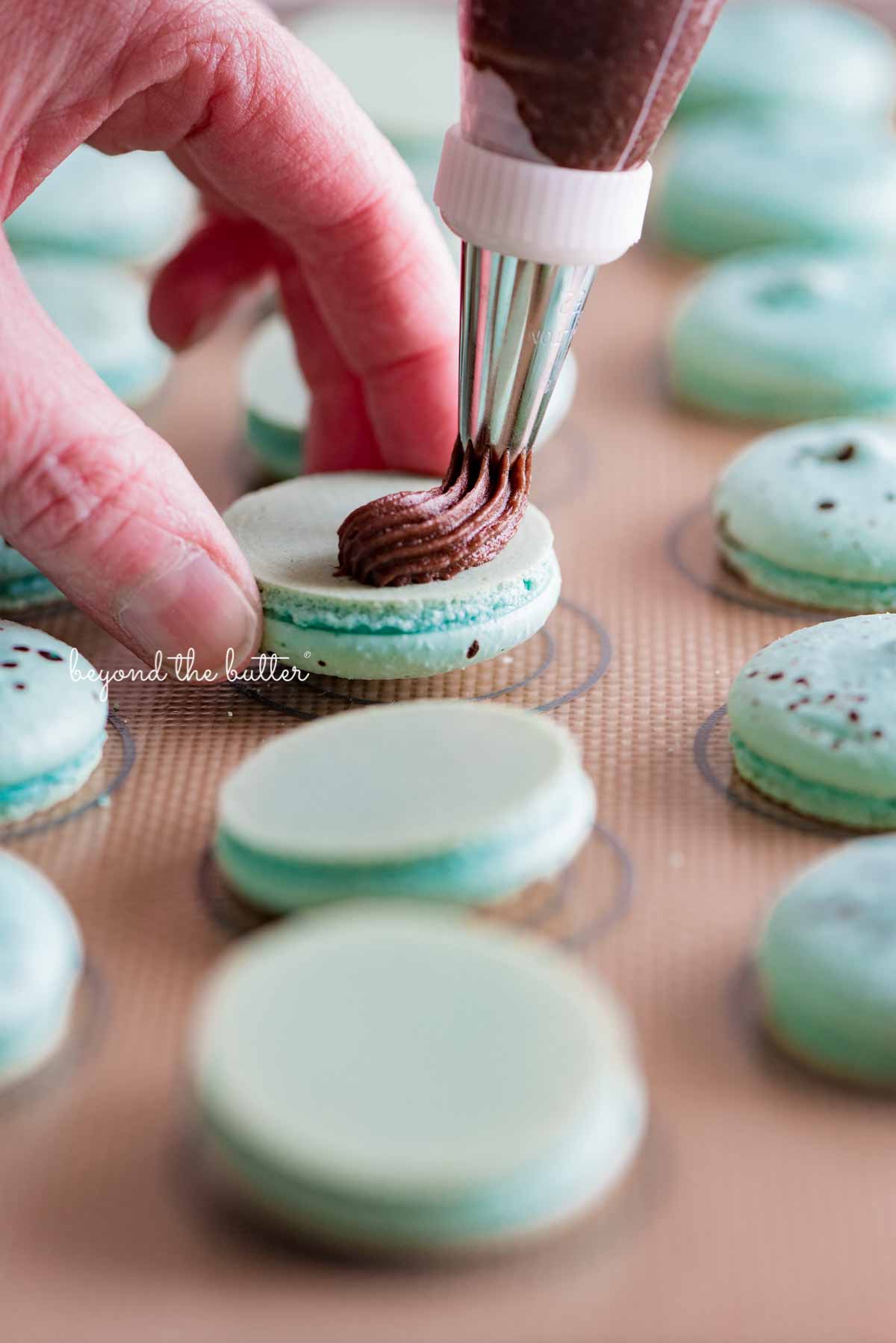


Helpful Tips
Here are a few tips to make your macaron baking smoother and less stressful. For a longer list, see my Dark Chocolate Macarons page.
Keep it clean. Wash every baking tool you plan to use for these robin’s egg macarons very thoroughly. A paper towel soaked in a little white vinegar removes any grease left behind.
Sift, sift, and sift again. Don't skip sifting the almond flour and the Domino® powdered sugar for macarons. Sifting each at least twice works best, then whisk them together at the end. A food processor can also pulse the ingredients until they're well blended.
Keep in mind: the finer the dry ingredients, the smoother your macaron shells will be!
Room-temperature egg whites matter. They whip into a better meringue and take less time too. Take your eggs out 1-2 hours before you start, then separate the whites.
Leave no yolk behind. When you separate the eggs, make sure no yolk gets into the whites. Even a little will throw off the meringue! You can use the shell or your clean fingers to separate them.
Use the finger test. To confirm the sugar has fully dissolved into the egg whites, rub a little of the mixture between your thumb and pointer finger. If you feel any grit, keep whisking. The simmering water won’t burn your fingers during this test. Don’t skip it.
Macaronage test. When the batter is ready to pipe, it will fall in ribbons or form a figure 8 without breaking. Keep folding until you reach that point, then stop right away.
Keep it perpendicular. Hold the piping bag straight up and down over the mat when you pipe the circles. If you tilt it, the macarons will most likely come out lopsided.
Bang, bang, bang. Tap the baking sheets on the counter 3-4 times to bring air bubbles up to the surface. Then pop them with a toothpick.
Let them rest. Resting, or drying, time depends on how humid it is where you live. For these robin’s egg macarons I suggest 40 minutes.
A ceiling fan running overhead helps too. The shells are ready once the tops are dry and no longer tacky to the touch.
Piping bag pint glass. If you can’t hold the bag steady with just your hand, a pint glass is a lifesaver. After fitting the bag with your tip (and a coupler, if the tip is large), set the bag inside the glass and fold its top edge over the sides.
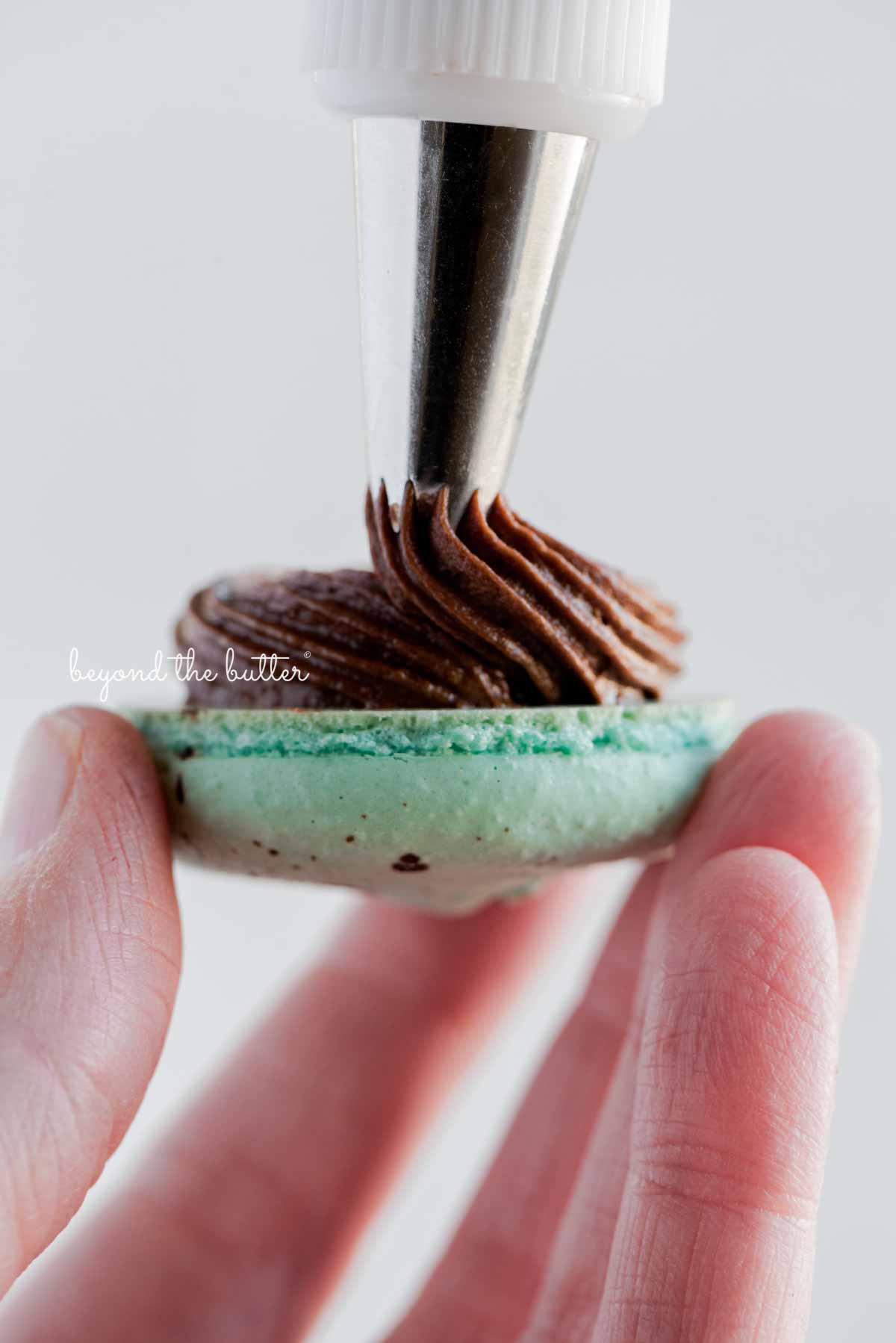
Storage
Keep unfilled robin’s egg macaron shells in an airtight container in the refrigerator or freezer until you need them.
Once filled with chocolate frosting, the robin’s egg macarons keep best in an airtight container in the refrigerator or freezer. They taste their best after 2-3 days in the refrigerator.
Troubleshooting and FAQs
My sugar and egg white mixture isn’t forming stiff peaks!This usually happens when the mixing bowl or whisk attachment was not cleaned well enough (leftover grease or fat from earlier baking can cling to them), or when the egg whites were not at room temperature.
How long does it take for the sugar and egg white mixture to form stiff peaks?Stiff peaks can take up to 10 minutes to form. Make sure the mixer is on high speed.
What is another way to test when your macaron batter is ready for piping?Place a teaspoon of batter on a small piece of parchment or a silicone mat. If it stays stiff and won’t spread, fold the batter a few more times.
Why are my macaron shells lumpy looking?This is most likely caused by not sifting and blending the dry ingredients enough. Remove any lumps left in the sifter instead of forcing them through.
Why did my macaron shells come out lopsided?There are several possible causes: overmixing, the way you piped the batter onto the mats, opening and closing the oven door during baking, or baking sheets that didn’t allow enough airflow.
My macarons are sticking to the mat/paper after baking!First, let the macarons cool completely before you try to lift them. If they still won’t release, put them in the freezer for about 15-20 minutes.
P.S. Even if a few macaron bottoms look imperfect, that’s fine! Just pipe frosting over them.
Yes, the milk chocolate fudge frosting can be made 2-3 days ahead. Let it stand at room temperature for about 1 hour before using. Mix it briefly with a hand mixer to bring back its creamy texture.
How many drops of blue food coloring did you use?I used 2 drops of gel food coloring. The color will fade a little as the shells bake.
What if I want a lighter brown color for the flecks of brown on the macaron shells?Mix a 1/4 teaspoon of vanilla extract into the drop of food coloring. This thins it out and gives you a lighter brown.
More Macaron Recipes You Might Like
Speckled Robin's Egg Macarons with Milk Chocolate Fudge
This robin's egg macarons recipe layers vanilla macaron shells around a rich milk chocolate fudge frosting and toasted coconut flakes. It’s a cheerful, delicious treat for Easter and spring. Makes about 22 fully assembled macarons.
- Prep
- 25 mins
- Cook
- 14 mins
- Resting Time
- 40 mins
- Total
- 1 hr 19 mins
- Makes
- 22 servings
Ingredients
robin’s egg macaron shells
- 1 cup Almond Flour, sifted
- ¾ cup Domino® Powdered Sugar, sifted
- 3 Large Egg Whites, room temperature
- ½ cup Domino® Golden Sugar
- 2 tsp Vanilla Extract
- 2-3 drops Blue Food Coloring, gel preferred
- 1 drop Brown Food Coloring, plus 1/4 tsp vanilla extract for thinning (if needed)
- 1/3 cup Coconut Flakes, toasted (optional)
milk chocolate fudge frosting
- ⅓ cup Unsalted Butter, room temperature
- ⅔ cup Domino® Powdered Sugar
- ¼ cup Unsweetened Cocoa Powder
- ⅛ tsp Salt
- ¼ cup Light Corn Syrup
- ½ tsp Vanilla Extract
- 2 oz Milk Chocolate, melted and cooled
Method
- Line 2 baking sheets with parchment or silicone mats. Fit a large piping bag with a round tip and set it aside.
- Weigh every ingredient on a food scale.
- Sift the almond flour and Domino® powdered sugar together twice, discarding any bits left in the sifter. Whisk once more to blend fully (or use a food processor).
- In a double boiler, heat the Domino® Golden Sugar and egg whites over 1 – 1.5 inches of simmering water. Keep whisking until the sugar dissolves and the mixture looks frothy (about 5-6 minutes). Rub a little between your pointer finger and thumb to be sure no sugar granules remain.
- Pour the hot mixture into the bowl of a stand mixer fitted with the whisk attachment, and set the speed to high. When it reaches soft peaks, add the vanilla extract. Keep mixing on high until stiff peaks form (about 10 minutes). The meringue should look glossy and hold its shape when you turn the whisk upside down. Add the 2-3 drops of blue food coloring and mix until fully combined.
- While the meringue forms, put 1 drop of brown food coloring in a small bowl. If your coloring is thick or you want a lighter brown, stir in 1/4 teaspoon of vanilla extract. Set it aside.
- Use a spatula to gently fold in half of the dry ingredients into the stiff meringue, stopping once most of them are incorporated. Then add the rest of the dry ingredients.
- Keep folding and press the batter against the side of the bowl. Continue until it has the consistency of lava. When the batter drops off the spatula in ribbons, or can form a figure 8 without breaking, it’s ready to pipe. If not, fold 2-3 more times and test again.
- Once it’s ready, scoop the batter into the prepared piping bag. Hold the bag straight over the silicone mat (or parchment) and pipe circles about 1.5 inches across. After you bang the sheets on the counter, the circles should spread just slightly.
- Tap the baking sheets on the counter 3-4 times to release air bubbles. Use a toothpick to pop any you can see.
- Dip a small brush into the cup of brown food coloring and vanilla mixture. Hold the brush about 6-8 inches above the macarons and tap it with your pointer finger so specks drop over each shell.
- Set the trays of shells aside somewhere cool and dry to rest for 40 minutes. They are ready to bake when the tops are dry and no longer sticky. A ceiling fan helps if you have one. Drying time depends on your location: the more humid it is, the longer they need.
- Near the end of the rest, preheat the oven to 300ºF and place the rack on the 2nd level (just above the middle).
- Bake only 1 tray of the macarons at a time for 14 minutes at 300ºF, rotating the baking sheet at the 7 minute mark. Do not skip this step. And other then opening the oven door to rotate the macarons, do not open it while baking.
- When they’re done, take the macarons out and let them cool for 10-15 minutes. If the shells are still a little tacky, leave them to cool at room temperature or put them in the freezer for 15-20 minutes.
- If you won’t be piping the frosting until the next day, keep the shells in an airtight container in the freezer or refrigerator.
- Put the coconut flakes in a small skillet over low-medium heat. Stir constantly as they warm and start to turn golden brown, about 4-5 minutes. Take them off the heat and spread them on a plate to cool. For making ahead, store the toasted flakes in an airtight container at room temperature until needed.
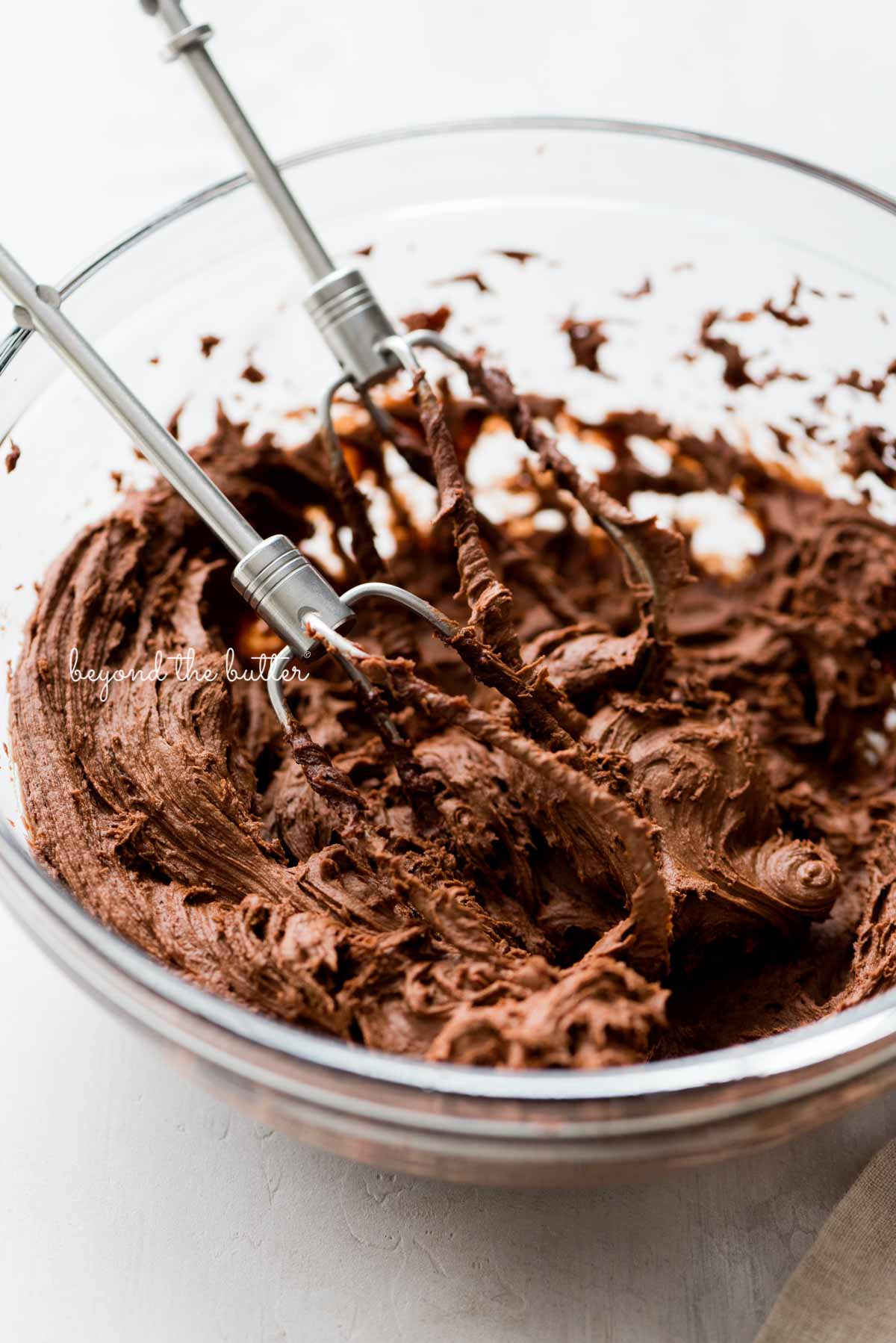
- With a hand mixer or stand mixer fitted with the paddle attachment, beat together the unsalted butter, sifted Domino® powdered sugar, unsweetened cocoa powder, salt, light corn syrup, vanilla extract, and melted milk chocolate on low speed until smooth and fully combined. Scrape down the bowl sides with a spatula as needed.
- Fit a small to medium piping bag with a coupler and a small decorating tip, then fill it with ¾ of the frosting.
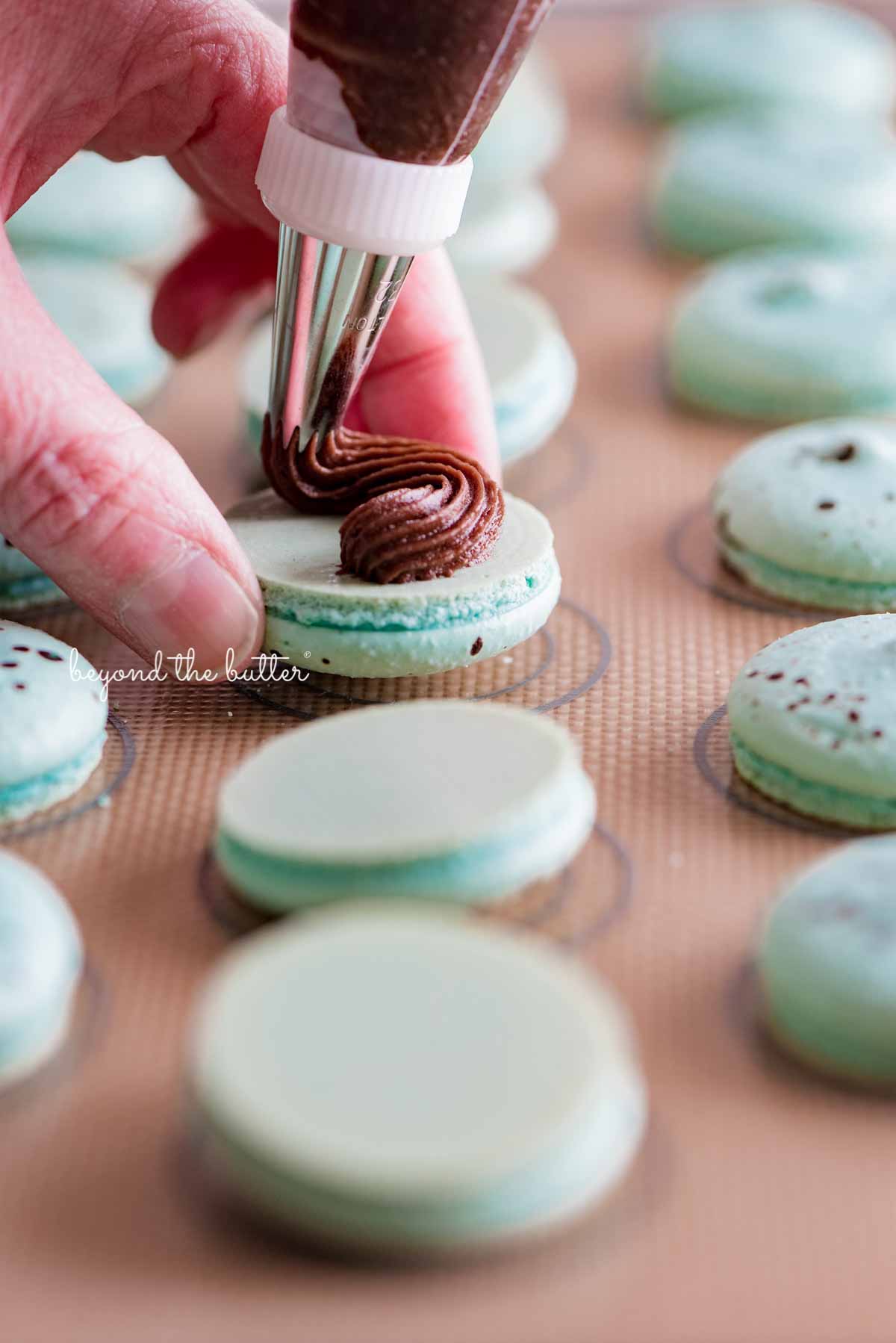
- Pipe a ring of milk chocolate fudge frosting onto one macaron shell, sprinkle a few toasted coconut flakes in the center, then gently press a second shell on top. Repeat until all the shells are used. Keep any leftover frosting in the refrigerator for up to 1 week.
- Store the robin’s egg macarons in an airtight container in the refrigerator. They taste best after sitting in the refrigerator for 2-3 days.
Baker’s notes
- Wash every baking tool you plan to use for these robin’s egg macarons very thoroughly. A paper towel dampened with a little white vinegar removes any leftover grease.
- Never skip sifting the almond flour and Domino® powdered sugar when making macarons.
- Room-temperature egg whites are essential. Take your eggs out 1-2 hours before you start, then separate the whites.
- When you separate the eggs, keep every trace of yolk out of the whites. It will ruin the meringue!
- Rub a little of the sugar and egg white mixture between your thumb and finger to check that the sugar has dissolved. If you feel any grit, keep whisking.
- When the batter is ready to pipe, it will fall in ribbons or form a figure 8 without breaking. Keep folding until you get there, then stop right away.
- Hold the piping bag perpendicular to the mat when you pipe the circles.
- Tap the baking sheets 3-4 times to bring air bubbles to the top, then pop any stragglers with a toothpick.
- The 40-minute drying time for these robin’s egg macarons will change depending on where you live. They are ready to bake once the tops are dry and no longer sticky.
- If you can’t hold the piping bag steady with just your hand, a pint glass makes it much easier.
- When you add the brown food coloring flecks to the macaron tops, a few specks will land on your hands and counter. Warm soapy water cleans them right off!